Departmental Operations: Why Nothing Works And What We're Going To Do About It
TL;DR (Summary)
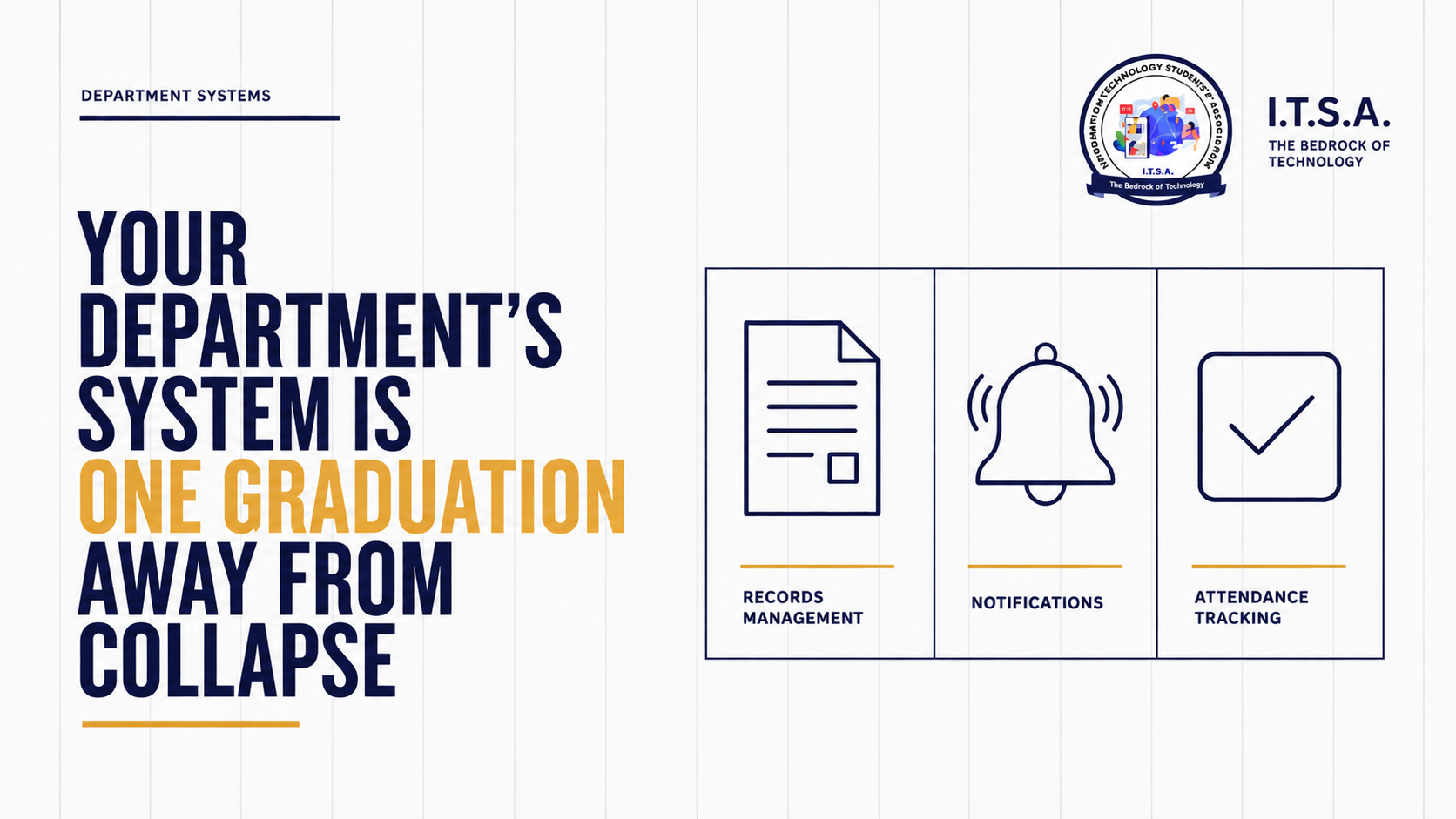
Every year, new excos inherit broken systems and rebuild from scratch. WhatsApp groups lose announcements, Google Forms can't track continuity, and knowledge dies when leadership graduates. The real gap isn't effort it's infrastructure that survives past the people currently in office.
Every year it's the same thing.
New excos come in. They inherit a WhatsApp group, a stack of screenshots nobody can find, and a system that only worked because one particular person was around to hold it together in their head. Then that person graduates. Or gets tired. Or just stops replying to messages. And the whole thing quietly falls apart until the next set of excos rebuilds it from scratch, badly, under pressure, during exam period.
Nobody plans for this. Nobody is supposed to have to.
The WhatsApp Problem
Let's start with the WhatsApp group, because that's where most of this breaks first.
You'd think a WhatsApp group is enough. It's free, everybody already has it installed, and you can just drop a flyer and move on. But here's the actual problem: WhatsApp was built for conversation, not for storage. Every announcement you post is competing with birthday messages, someone asking "who has the IFT 212 note", and forwarded memes. Important information doesn't sit at the top where people can find it later, it sinks. By the time someone needs that event form deadline you posted three weeks ago, it's buried under four hundred unread messages and nobody's going to scroll for it.
That's not a WhatsApp problem exactly. It's a "we're using the wrong tool for the job" problem. And it repeats itself everywhere in how departments are run.
The Continuity Gap
Now the part about new excos and continuity.
Here's what actually happens. A set of excos comes in, and whatever they're using to organize things, be it a spreadsheet, a shared drive, or literally just memory, exists mostly in their heads and their personal chats. When their tenure ends, that knowledge doesn't transfer. The next set doesn't inherit a system, they inherit a vague idea that a system used to exist. So they either recreate it from zero, or they don't bother, and things get worse. This is why departmental operations feel like they reset every single year instead of improving. There's no memory. There's no infrastructure that survives past the people currently in office.
Google Forms Isn't Enough
And then there's Google Forms, which gets used for almost everything because it's the only tool most people know.
Google Forms is fine for a one-off survey. It is not fine for tracking who paid dues, who submitted a project, who's owed a refund, or who needs a follow-up. The moment you need to cross-reference anything, or update a single response after submission, or see this data next semester, Forms falls apart. People end up exporting to Excel, manually checking rows, and still missing people. Multiply that by every single process a department runs in a year, and you start to see why everything feels like it's held together by tape.
What's Actually Going On
So what's actually going on here.
It's not that people aren't trying. It's not that nobody cares. It's that departments keep solving operational problems with communication tools, and those are two completely different jobs. A WhatsApp group is for talking to people. A form is for collecting one-time input. Neither of those is built to hold a system that needs to survive changeover, track state over time, or work the same way whether the person running it graduated last week or joined yesterday.
That's the actual gap. Not effort, not intention, infrastructure.
Building Real Infrastructure
And building that properly is not a "hire a good team" answer, because that tells you nothing about what to actually do. It means someone has to sit down and map out what data needs to persist beyond a single tenure, what needs automation instead of a person manually checking a spreadsheet, and what needs to be documented so it doesn't die with whoever built it.
That's what I'm working on. Not a speech, not a slogan, an actual system built to outlive whoever's in office.
If you're an exec dealing with this now, or about to be, that's the conversation worth having.